
At DSV, our Seafreight division is helping customers move containers to and from UK ports more sustainably, efficiently, and reliably.
Inland transport is one of the largest contributors to supply chain emissions, and decarbonising Seafreight container movements remains a key challenge for many businesses. With HGVs accounting for around 17% of UK transport emissions, customers are increasingly seeking low carbon solutions that work at scale — without compromising service.
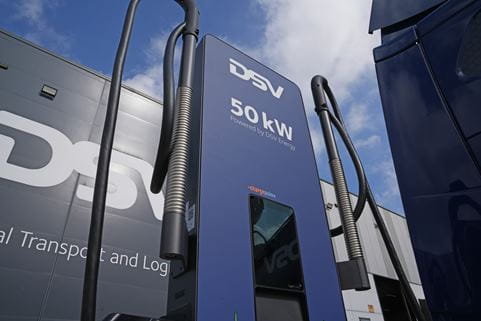
To support this, DSV is investing in zero emission transport infrastructure and operations dedicated to container flows. Once fully operational, we will have access to ZERO charging hubs delivering 17.5 MW of installed power, enabling the simultaneous charging of up to 102 electric HGVs. Charger capacities range from 100 kW to 1 MW, providing the flexibility required for both short haul and longer distance inland container movements.
Our electric HGV fleet supporting Seafreight continues to grow rapidly. With 25 vehicles already in operation and a further 40 trucks entering service by the end of June, customers can now access significantly enhanced zero emission capacity for container transport between ports and inland destinations.
When combined with our established rail freight services, DSV offers one of the UK’s most comprehensive low carbon multimodal solutions for Seafreight containers. This enables customers to reduce their carbon footprint while maintaining the reliability, visibility, and scalability their supply chains demand.
By choosing DSV’s electric road, rail, and multimodal solutions, customers can take a practical step towards their sustainability goals — today and for the long term.
As BEV technology evolves, a number of misconceptions still exist. Our real world experience shows that electric HGVs are already delivering consistent, reliable performance across a wide range of operating conditions.
Myth: BEVs struggle in cold weather
Modern electric trucks are designed to operate year round. Volvo Trucks report that range drops by just 3% at –10°C. Battery pre conditioning and regenerative braking help maintain optimal performance, and with smart route and charging planning, BEVs run reliably in all seasons.
Myth: BEVs don’t have enough range for commercial operations
Current electric HGV models already deliver up to 500 km per charge in real world conditions. Longer range trucks are currently in testing, with ongoing developments continuing to extend operational reach.
Myth: BEVs can’t handle heavy loads
Our electric vehicles are already operating at up to 42 tonnes, and we are actively working to increase this capability further. This ensures we can offer customers a competitive BEV solution for even the most demanding freight requirements.
Myth: Charging takes too long
Charging is built directly into operational schedules. Vehicles are routinely topped up during loading, unloading, and driver breaks, keeping downtime to a minimum. As high speed and megawatt charging technology continues to advance, charging times will reduce even further.


