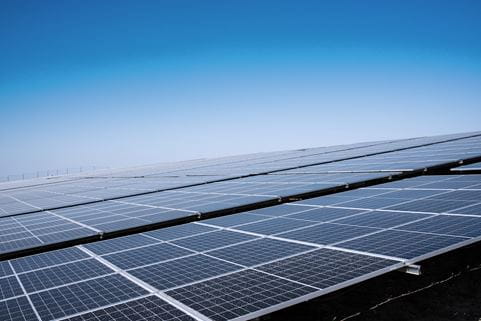
Energy self-sufficiency is one of the most important tools available to the contract logistics sector in the decarbonisation process. The Polish branch of DSV – Global Transport and Logistics, the world’s largest logistics operator, in cooperation with Accolade, a commercial real estate investor, has launched a photovoltaic installation in Łozienica. The installation will ultimately meet the energy needs of Poland’s first multi-client warehouse equipped with an AutoStore system.
Investment in Sustainable Development
DSV – Global Transport and Logistics has committed to achieving net-zero emissions by 2050. To achieve this goal, the operator has adopted rigorous roadmaps within its long-term business development strategy – developed individually for each of its three main areas of activity: sea and air freight forwarding, road transport, and warehousing logistics.
The climate transition is an enormously complex process, particularly from the perspective of the logistics industry. On one hand, our sector is the backbone of the entire economy, enabling the transport and storage of goods, while on the other hand, it is a significant emitter of greenhouse gases across value chains – notes Agnieszka Kłopotowska, Senior Sustainability Manager at DSV – Global Transport and Logistics – However, the fact that something is a challenge does not exempt us from taking action. As DSV, we feel responsible for the sector’s impact on the environment and we see the effects of an increasingly rapidly changing world. It is precisely from this sense of responsibility – and in order to strengthen the organisation’s resilience to risks – that we are today investing in solutions that will enable us to maintain the predictability and quality of service delivery in the future and reduce our environmental impact.
Direction: Energy Self-Sufficiency
One of the most effective methods of reducing the environmental impact of warehousing operations is limiting the energy consumption required to power facilities – both thermal and electrical. In this regard, DSV, independently or in partnership, carries out global and local projects, investing in solutions that contribute to the set CO₂ emission reduction target.
The warehouse in Łozienica near Szczecin is home to one of the most advanced logistics centres managed by DSV in Poland. It was here, in 2024, that Poland’s first multi-client solution based on the automated AutoStore system was made available. After just one year of operation using robots, electricity consumption was reduced by 11 per cent – compared to the non-robotised part of the warehouse and the period before the AutoStore system was installed. This difference is partly due to the higher storage density. On just under 2,000 square metres, the volume stored would require 12,000 square metres of space in a traditional facility, along with appropriate lighting and additional heating.
In January 2026, in cooperation with Accolade, the building owner, a 120 kWp photovoltaic installation was launched on the roof of the facility. This will allow 100 per cent of the robotised storage system’s electricity needs to be covered. Any surplus not used by the robots will be used to power the lighting systems in the office and welfare areas of the warehouse, as well as to charge the lithium-ion batteries of the forklifts used on the Łozienica warehouse site for operations in the “traditional” model.
The Szczecin installation is not the first solution of this type that DSV has used in Poland. That title belongs to the location in Sosnowiec, where the energy produced is used for the common needs of the property. However, the Szczecin installation has the greatest capacity – the rooftop power plant in Łozienica can be compared to 24 typical installations on single-family homes. This project would not have been possible without the full openness and willingness to cooperate on the part of the building owner, Accolade. It is thanks to the cooperation of specialists from both our organisations that we identified and implemented the solution with the greatest potential, which has generated 11 megawatt-hours of clean energy from the beginning of the year to 20 March 2026. – says Marcin Muś, Senior Manager Facility and Maintenance at DSV – As DSV, we take action with our clients, colleagues and local communities in mind. At the same time, we hope that these real-world implementations will serve as inspiration for the entire TSL market.
Warehouse rooftops are increasingly ceasing to be merely structural elements and are beginning to serve as a real energy source for tenant operations. The 120 kWp installation we launched together with DSV shows that commercial real estate can actively support the decarbonisation process – not just at the level of declarations, but through specific operational solutions. – says Mirosław Gromek, Transformation & Innovation Manager at Accolade – We clearly see that tenants are increasingly combining operational automation with energy consumption optimisation – one example being the combination of the AutoStore system with the photovoltaic installation at Gole niów Park. This is a direction that will gain in importance, as it directly translates into both cost efficiency and long-term business resilience.
Business Expects Real Action
DSV’s efforts to reduce emissions are part of broader global trends. The largest companies view sustainable development not as an obligation or a passing trend, but as a strategic tool for building long-term corporate resilience.
This is confirmed both by data on management opinions and by actual investment decisions. A survey conducted by investment bank Morgan Stanley among 330 managers of companies with revenues exceeding USD 100 million found that as many as 88% of them view sustainable development as a business opportunity. Meanwhile, the 2025 Deloitte report, based on an analysis of more than 2,000 organisations from 27 countries, indicates that 83% of them increased their sustainable development spending by at least 5% over the course of the year.
The rapid growth in interest in sustainable development solutions is also visible in requests for proposals sent to logistics operators by clients in Poland. Solutions in the area of decarbonisation are increasingly being indicated not as an additional element, but as a mandatory part of an offer.
Nasi eksperci są gotowi do pomocy.
Skontaktuj się z nami, a znajdziemy potrzebne Ci rozwiązanie.