
February 2026
Road transport market update
Welcome to…
The first edition of our expanded Road Transport Market Update, which marks a shift beyond Europe - now offering a global view of the road transport landscape.
The first section of the update will present the latest developments in the transport market by region, the second section gives you deep dives into weather pressures, battery electric vehicles and an insights from Peter Fog-Petersen, DSV Executive Vice President, Direct & Special Products.


Region Europe
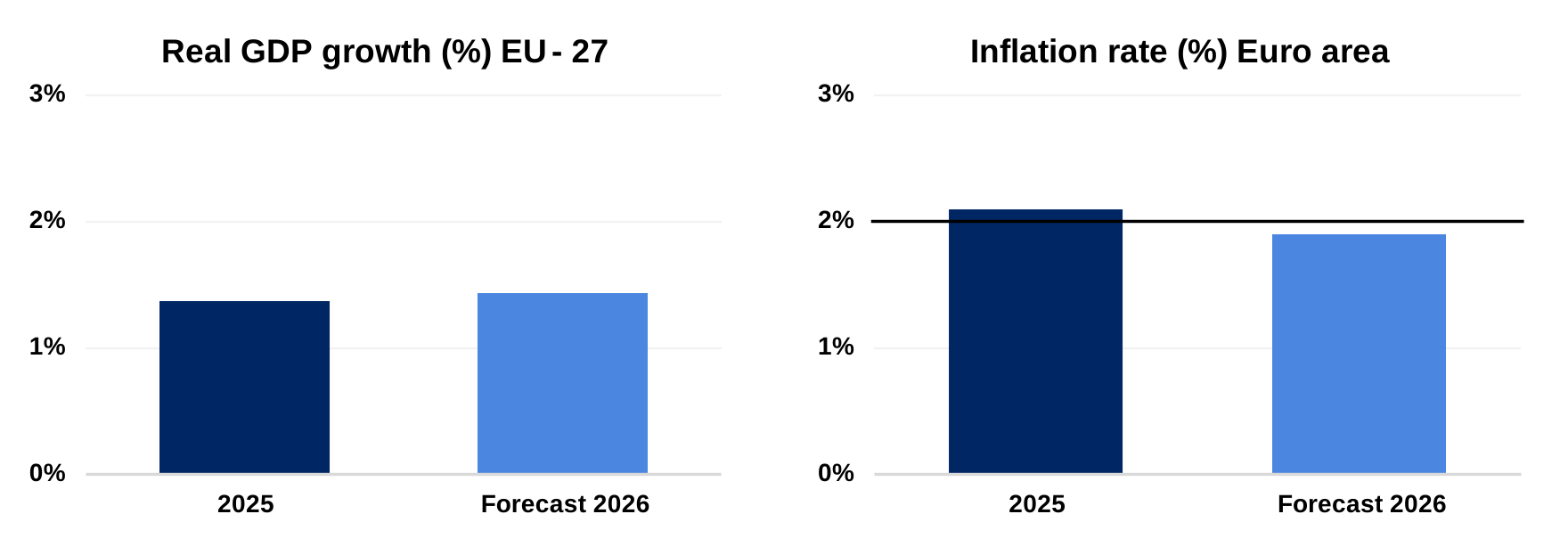
Economic development


Transport market development
Supply & Demand: Capacity & Rate Index
- The Transporeon Capacity Index for the european market dropped to 93.6 points in December 2025, marking the second-lowest value in 2025 and a 5.5 percent decline year on year. In January 2026, the index dropped further to 90.4 points, highlighting a severe capacity shortage.
- The Spot and Contract Rate Index both increased in December 2025, with the Spot Index rising to 146.1 points (+ 4.3% YoY) and the Contract Index reaching 130.7 points (+ 4.1% YoY). In January 2026, the Spot Index fell but is still at a high level, while the Contract Index went up slightly.

European Truck Toll Changes expected during H1 2026
Americas
Inflation rate
Inflation held near 2.7% in December, still above the Fed target but not re-accelerating; PPI rising faster than CPI suggests businesses are absorbing some cost pressure.
Core inflation (ex-energy, food, alcohol, tobacco):
- U.S.: ~2.7% YoY
- Canada: ~2.5% YoY
- Mexico: ~4.3% YoY
Market Developments
U.S. economy remains sluggish but not recessive, with 2025 GDP growth appearing solid but distorted by volatile trade flows and tariff impacts.
Trade policy uncertainty has driven unusual swings in imports and exports, complicating historical comparisons and business planning.
Labor market shows signs of stagnation: unemployment dipped to 4.4%, but job growth slowed sharply, reflecting a “low hire, low fire” environment.
Consumers outperformed expectations during the holiday season, driving strong retail sales and rapid inventory drawdowns.
Overall macro-outlook tilts modestly optimistic, though policy uncertainty remains a key headwind.
Consumer Price Index
- U.S.: ~2.7% YoY in December 2025; monthly CPI gains ~0.2%–0.4% during Q4
- Canada: 2.4% YoY in December (up from 2.2% in November)
- Mexico: ~3.7% YoY at year-end; monthly increases moderated in Q4
- South America: Wide dispersion — low single-digit inflation in Chile/Peru vs. elevated inflation in Argentina and Bolivia
We forecast U.S. crude oil production will remain close to the 2025 average on an annual basis in 2026 before falling by 340,000 barrels per day (b/d) in 2027. Although there were 13% fewer rigs drilling for oil in the United States at the end of 2025 than there were at the beginning of the year—according to Baker Hughes—production reached a record high last year as rising well-level productivity outweighed this drop. Over the next two years, we expect sustained lower crude oil prices will result in a pullback in drilling and completion activity that is enough to outweigh ongoing increases in productivity.
APAC
Economic development
- GDP growthis moderating, easing from ~4.5% in 2024–25 to ~4.1% in 2026. Growth remains uneven, with India and parts of Southeast Asia (e.g. Vietnam, Philippines) outperforming, while North Asia and Singapore see slower momentum.
- Inflationhas cooled but not normalized, leaving fuel, labor, compliance, and financing costs structurally higher than pre-2020 levels.
Market Update
- Thailand floods (Nov 2025): short-term, localized disruption; operations normalized.
- Thailand–Cambodia border: policy-driven disruption; geopolitical risk persists.
- Intra-Asia trucking: lead times stable but lane-specific; buffers increasingly used
Road tolls/regulations
Malaysia has tightened enforcement on lorry overloading, introducing zero tolerance with nationwide inspections and stricter weight-limit checks.
Penalties have increased, including heavy fines, vehicle seizure, and license suspension for repeat offenders, raising compliance risks for operators.
Stricter load planning and documentation are now essential, with enforcement expected to remain sustained rather than temporary.
Source: 1) ©IMF, 2025 World Economic Outlook (October 2025) - Real GDP growth 2) World bank Group Inflation, consumer prices (annual %) | Data
MEA
Economic development
GDP: Growth remains uneven across MEA, with GCC economies outperforming South Africa despite a gradual recovery.
Inflation: Inflationary pressures have moderated, though price levels remain elevated across the region.
Road tolls / Regulations etc.
Regulatory changes across MEA are increasing operational complexity and cost pressures, particularly for cross-border road freight.
Country
|
Regulation
|
Effective
|
Impact
|
Namibia |
Trader Identification Number (TIN)
|
Apr-26
|
Mandatoryfor all customs transactions, increasing
administrative compliance for cross-border operators
|
United Arab Emirates
|
Expanded TIR / RoRo corridors
|
Ongoing
|
Faster cross-border transit and improved
route flexibilityfor regional road freight
|
Saudi Arabia |
Market linked diesel pricing and Saudization requirements
|
Ongoing
|
Higher operating costs and
labour constraints for road transport operators
|
South Africa |
Permit and road compliance enforcement
|
Ongoing
|
Higher compliance, security,and
operating costs for road freight operators
|
Sources: NAMRA Namibia Revenue, ATCUAE Ass of Transport Companies, MOTLS Ministry of Transport and Logistics Services, DoT ZA Department of Transport
Market Developments / Challenges / Trends
- Demand remains strong in construction, retail, e-commerce,and healthcare distribution, supporting consistent road freight activity, particularly in Saudi Arabia
- Specialised transport, including temperature-controlled freight, continues to gain traction across Middle East corridors
- Security risks and infrastructure constraints in South Africacontinue to add costand operational complexity
- Customers across the region increasingly prioritise reliability, compliance, and visibility over purely price-driven solutions
Transport Capacity and Fuel prices
- Fuel pricing across MEA has largely shifted to market-linked models, resulting in ongoing cost volatilityfor road operators
- Recent diesel price increases 8% in Saudi Arabia contrast with short-term fuel price relief announced in South Africa
- Capacity remains tight in specialised and peak-demand segments, particularly for long-haul and controlled cargo
- Fleet efficiency initiatives, including the introduction of electric vehicles in South Africa, are gaining momentum
Battery electric vehicles momentum and challenges
Global demand for Battery Electric Vehicles (BEVs) continues to accelerate, with China showing particularly strong momentum. In the first half of 2025, electric heavy trucks reached a 22% market share in China. Adoption varies significantly by country, largely influenced by government subsidies, zero‑emission regulations, and tax policies. Competition is intensifying as both established and emerging OEMs expand into new regions. This increased activity is reshaping market dynamics and increases competition.
Vehicle performance is advancing, especially in driving range. New models now offer up to 600 km, enabling more operational use cases. Megawatt Charging System (MCS) infrastructure is emerging, currently limited but expanding. As availability grows, it will support faster charging, improving uptime and operational efficiency for heavy‑duty electric fleets.
We see momentum for the scalability of battery‑electric trucks driven by advances in technology and the expansion of charging infrastructure.However, this scalability remains geographically uneven, requiring careful assessment of regional conditions and availabilities. To ensure reliable deployment, individual operational setups must be evaluated to identify the most effective implementation solutions.
Extreme weather adds pressure and complexity to road freight
Road freight operations are increasingly affected by extreme weather, which is becoming a more regular part of daily transport planning. Severe storms, snow, ice and heavy rainfall in early 2026 disrupted transport flows across North America and Europe, making it harder to access major hubs and slowing down regional networks. These conditions impacted everything from local deliveries to long‑distance cross‑border movements, causing delays across supply chains. The effects were felt right across the industry, with DSV and our competitors facing many of the same challenges as weather systems hit multiple markets at once.
As climate patterns shift, the transport environment is becoming less predictable. Longer warm spells, heavier rainfall, and more frequent storms are putting extra pressure on infrastructure and increasing the risk of delays. This creates a more changeable operating landscape, where planning and forecasting must adapt quickly to shifting weather conditions. For customers, this means supply chains may require more flexibility to keep goods moving when conditions change at short notice. To help customers navigate these challenges, DSV continues to strengthen the resilience of our network. Our global scale and agility make it possible to reroute shipments, adjust capacity and activate contingency plans when local conditions deteriorate.
Sources: transinfo(Europe’s January deep freeze exposed weak points in transport networks) Trasportoeuropa (Early 2026 bad weather paralyses transport across half of Europe) Lofret (Winter Storms Disrupt Northern and Western Europe’s Air, Port and Cargo Networks)
Raising the bar with Direct
Insights from Peter Fog-Petersen, Executive Vice President, Direct & Special Products
Customers continue to ask for the same thing: clarity, reliability, and a logistics partner who can simplify operations in an increasingly complex market. At DSV, we are expanding exactly that. One connected road network that offers control, confidence, and a consistent experience for every shipment, from groupage to direct.
"Our ambition goes beyond capacity. We are designing how a modern network should operate: integrating Direct and Groupage, so they function as one, consolidating planning into stronger hubs, and scaling our own production across key lanes. This raises the bar on speed, accuracy, and transparency; giving customers fewer handovers, better tracking, and a single standard of reporting wherever they trade. The benefit is felt end‑to‑end: booking is simpler, lead times are tighter, and delivery performance is more predictable."
As specialised needs grow, we are expanding our specialised products, with white glove, automotive and other solutions. Our Direct offering brings specialised products into a unified structure. One partner, one network, and one way of working, enabling our customers to manage diverse requirements through a single point of entry, backed by dedicated expertise and consistent visibility across regions.
DSV is about making logistics easier for our customers to manage. It is the confidence that your shipments are handled with the same discipline and the same transparency, whoever you are, wherever you operate, and whatever you ship.